Additional Educational Resources
You may have questions about insurance coverage. Read the information below to learn more
This site is intended for US audiences only.
 1-855-DATRO4U (1-855-328-7648)

You may have questions about insurance coverage. Read the information below to learn more
My co-pay for DATROWAY is too high. How can you help me?
The DATROWAY Patient Savings Program is available for commercially insured patients. The goal of the program is to remove cost as a barrier for eligible commercial patients by assisting with their out-of-pocket costs for DATROWAY. Talk to your doctor to sign up for the program or call DATROWAY at 1-855-DATRO4U (1-855-328-7648).
I cannot afford DATROWAY. What are my options?
There may be options to help you get DATROWAY. DATROWAY can refer you to patient assistance options such as the patient savings program, Patient Assistance Programs (PAP), and independent foundations.
Explore Your Options

My health plan denied coverage for DATROWAY
We have resources to help your doctor file an appeal. Your doctor’s office will need to file an appeal directly with your health plan. Have your doctor visit DATROWAY.com or call 1-855-DATRO4U (1-855-328-7648).
I no longer have or do not have health insurance. What do I do?
If you cannot afford your medicine, you may be able to get help from our Patient Assistance Programs (PAP). PAP can provide DATROWAY for free if you qualify. Eligibility rules apply. Please click here for more information regarding eligibility.
To understand insurance coverage, the following key terms will be helpful.
Brand-name drugs
Drugs marketed under a trade name by the manufacturer that develops and patents them.
Generic drugs
Once the patent (or license) expires on a brand-name drug, a generic chemically equivalent version can be developed and sold at a lower cost.
Premium
Payments made by patient to maintain insurance coverage. This is a monthly payment and varies by insurance plan.
Co-payments (Co-pays)
The set fee patients pay for a covered service every time that service is provided. Co-payments vary depending on the plan. Co-payments do not count toward a deductible but do count toward the annual out-of-pocket maximum for most services. Nearly all plans have co-payments or co-insurance.
Co-insurance
The percentage of the cost the patient pays for a covered service. Co-insurances vary according to the plan and do not apply toward deductibles. However, they do count toward the annual out-of-pocket maximum for most services.
Deductible
The set amount patients must pay each contract year for covered medical services before the insurance plan begins to pay its share. Patients with a deductible will be billed for the full allowable amount for each service that is subject to the deductible.
There are two types of health insurance, private and public. Private, or “commercial” health insurance is insurance you get from your job, or insurance you buy directly from an insurance company or exchange.
Public health insurance is provided by the federal or state government. This includes Medicare, Medicaid, Veterans Health Administration/TRICARE Department of Defense.
Private and public health insurance both include the medical benefit and the pharmacy benefit.
Medical benefit
Typically covers physician and hospital services for things like visits to the doctor, drugs administered by doctors, hospital services and supplies, and some home health services.
Pharmacy benefit
Typically covers prescription drugs taken by mouth, and self-administered injectable prescription drugs that are used at home.
Understanding Medicare
Medicare mainly provides coverage for people who are over the age of 65, blind, or disabled. This program pays for medical services and procedures that have been determined as “reasonable and necessary.” It is important to note that there are various parts of Medicare and benefits vary based on the type of coverage you select.
Medicare Part A
Hospital Insurance
Covers inpatient hospital services and certain follow-up care.
Medicare Part B
Medical Insurance
Covers medically necessary services and supplies. Also covers drugs prescribed and administered by a healthcare provider.
Medicare Part C
Medicare Advantage
Covers part A and part B benefits, and could also include prescription coverage.
Medicare Part D
Medicare Prescription Drug Coverage
These are private insurance plans specifically for prescription drug coverage.
Medicaid
Covers people with low incomes and some disabled people. Funded partly by the federal government and partly by individual states.
Veterans Health Administration/TRICARE DoD (Department of Defense)
Covers people who are or have been in the military, including:
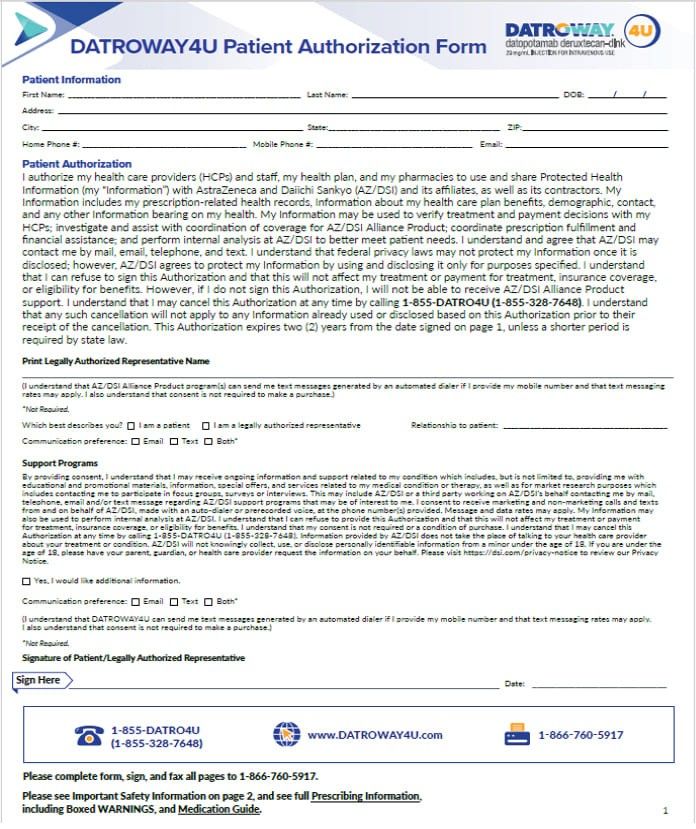
In order for you to receive DATROWAY4U program offerings, your doctor will complete an enrollment form. If you did not sign this form at your doctor’s office, you can give authorization in 1 of 3 ways:
DATROWAY4U: Patient Access to Treatment
What is the most important information I should know about DATROWAY?
DATROWAY can cause serious side effects, including:
Your healthcare provider will check you for these side effects during your treatment with DATROWAY. Your healthcare provider may reduce your dose, delay treatment, or completely stop treatment with DATROWAY if you have severe side effects.
See “What are the possible side effects of DATROWAY?” for more information about side effects.
What is DATROWAY?
DATROWAY is a prescription medicine used to treat adults who have:
DATROWAY was FDA approved for this use based on a clinical study that measured how many patients responded and how long they responded. DATROWAY is still being studied to confirm these results.
It is not known if DATROWAY is safe and effective in children.
Before receiving DATROWAY, tell your healthcare provider about all of your medical conditions, including if you:
Tell your healthcare provider about all the medicines you take, including prescription and over-the-counter medicines, vitamins, and herbal supplements.
How will I receive DATROWAY?
What are the possible side effects of DATROWAY?
DATROWAY can cause serious side effects, including:
The most common side effects of DATROWAY when used in adults with EGFR-mutated NSCLC include:
The most common side effects of DATROWAY when used in adults with TNBC include:
The most common side effects of DATROWAY when used in adults with HR-positive HER2-negative breast cancer include:
DATROWAY may cause fertility problems in males and females, which may affect your ability to have children. Talk to your healthcare provider if you have concerns about fertility.
These are not all of the possible side effects of DATROWAY. Call your healthcare provider for medical advice about side effects. You may report side effects to Daiichi Sankyo at 1-877-437-7763 or to FDA at 1-800-FDA-1088.
Please see Prescribing Information and Medication Guide for additional Important Safety Information.
DATROWAY® is a registered trademark of Daiichi Sankyo Company, Limited.
© 2025 Daiichi Sankyo, Inc. and AstraZeneca. All rights reserved. PP-US-DT-0119-3; US-113896 09/26